


Rev. Kanon Nakata Describes Her Experiences With Tokudo Ordination in Japan
Updated: Mar 12
Daughter and Wife of Rev. Kazuaki Nakata Are Both Recent Graduates of Chuo Bukkyo Gakuin in Japan
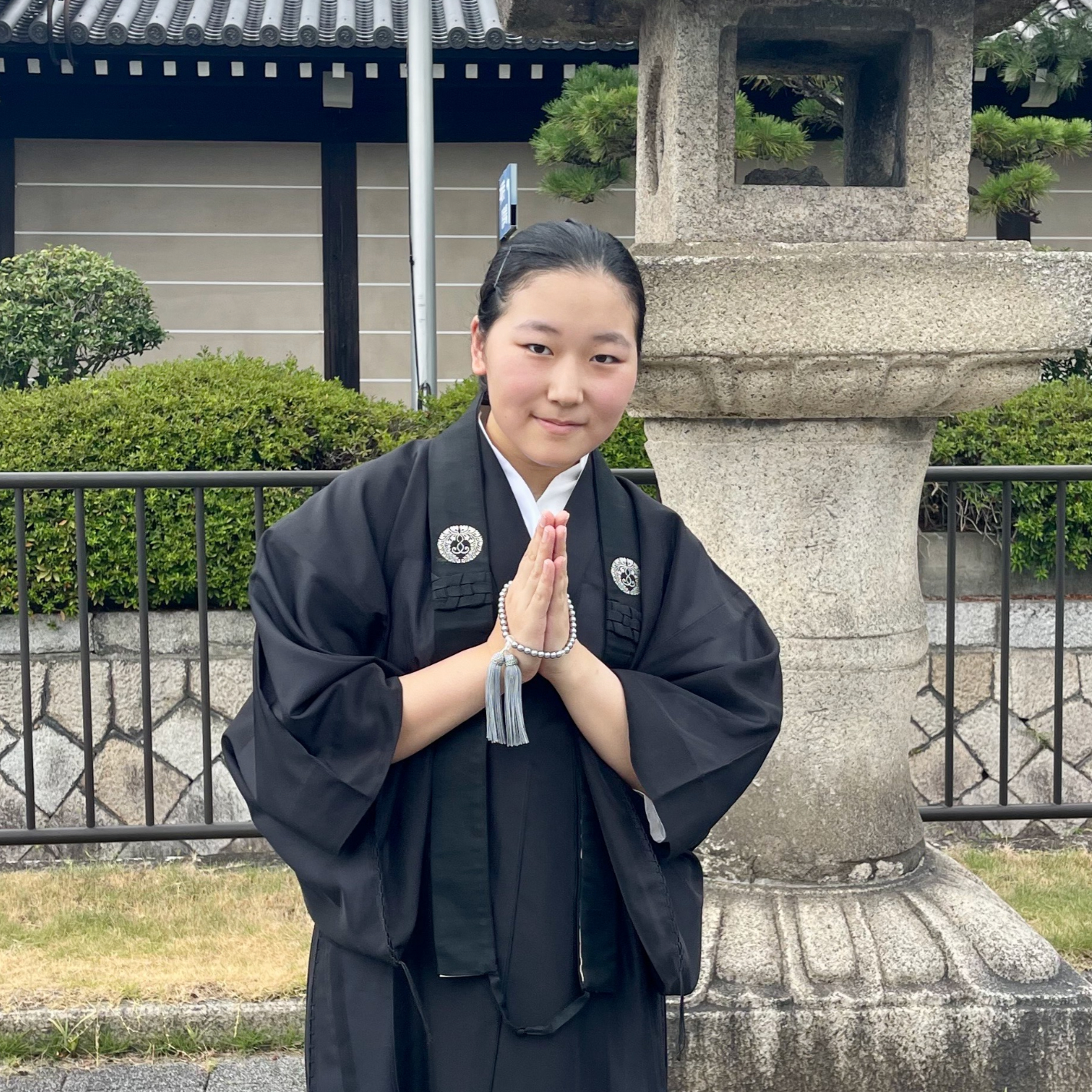
Editor’s note: Rev. Michiko Nakata and Rev. Kanon Nakata — the wife and daughter of Fresno Betsuin Buddhist Temple interim Rimban Rev. Kazuaki Nakata, respectively — both recently graduated from Chuo Bukkyo Gakuin, the Hongwanji Central Buddhist Seminary, and both received Tokudo ordination. Rev. Kanon Nakata, who is a senior at Clovis North High School, wrote an article about her experience. She is also a Fresno Betsuin youth Minister’s Assistant and President of the Central California Jr. YBA.

I felt the black robes clinging to me as I sat upright on the tatami. It was Aug. 6, 2025, my Tokudo ordination day.
The Gomonshu entered the naijin and the ceremony began. The hall was very dark with all the doors shut and heavy blackout curtains. The atmosphere felt solemn and ancient, something that Shinran Shonin himself might have experienced. The ordination was carried out in a deeply dignified environment, just as when Shinran Shonin first received Tokudo.
My path began in September of my freshman year, when I was accepted into the three-year online program at Chuo Bukkyo Gakuin, sponsored by Nishi Hongwanji.
I wanted to help my temple community in the same way I saw my father doing every week, welcoming questions and guiding people. The lessons came as video lectures on chanting and Buddhist history. They covered the history of Jodo Shinshu and Shinran Shonin, the essentials of our school’s regulations, Buddhist doctrine, sectarian laws, and the composition of Dharma talks.
Altogether, there were 20 courses over the three years. I often paused and replayed the videos. I filled the margins with furigana and simple notes. The language, often in old Japanese or classical Chinese, forced me to move slowly until the characters began to feel familiar. The exams required both multiple-choice and written essays. The free-response sections were the hardest for me since they demanded writing skills, complex concepts and many difficult kanji.
Every summer, I traveled to Kyoto for the examinations. I read each sentence piece by piece, trying to put together the meaning.
Because I grew up in the United States, my Japanese reading and writing were not strong, and the kanji felt heavy. The exams seemed closer to college level, while I was still trying to catch up. When it came time for chanting, I closed my eyes and let the key, rhythm and words bring back what I had memorized. I also had to prepare a Japanese Dharma talk, memorize it and deliver it before everyone.
In June 2025, I took the final exam. Having successfully passed all the tests over three years, I was told that I could graduate.
The 11-day Tokudo training brought together many different people. Some were ministers’ children. Others were older adults seeking to carry Buddhism into their lives.
One of the things that was hard for me was seiza. My legs went numb and hurt when I stood up. Between classes, I kept rehearsing the Shoshinge in my head as I waited for the chanting test. During the training, cell phones, television and sweets were prohibited and conversation outside our rooms was not allowed. We studied intensively the mindset, etiquette and conduct required of a minister.
Classes filled every day. I scribbled notes across my worksheets and hoped they would stay in my memory, even with only six hours of sleep, going to bed at 11 p.m. and rising at 5 a.m.
I also made friends. We talked about why we were there and I learned perspectives I never would have heard otherwise. We still plan to keep in touch and visit one another’s temples.
Looking back on these three years, I remember what my father always says: “To be Buddhist is to be a lifelong learner.”
I want to carry these teachings into my life and share them as I meet new people. Both the three years of study and the 11 days of training will always remain with me as I move forward. They have given me a deeper understanding of Buddhism and of how to live by bringing its spirit into daily life. This new perspective will allow me to keep learning alongside others.

Taking these classes together with my mother was also unforgettable. We enrolled at Chuo Bukkyo Gakuin at the same time, became classmates, studied together, practiced chanting, debated and ultimately received Tokudo together. That shared journey with her will always remain one of my most treasured memories.
There will be challenges, but I will continue, keep learning and strive to always live with the heart of a learner.


Comments